
Tech
How to Balance Engineering Studies & Automotive Passion: A 2026 Guide for Students

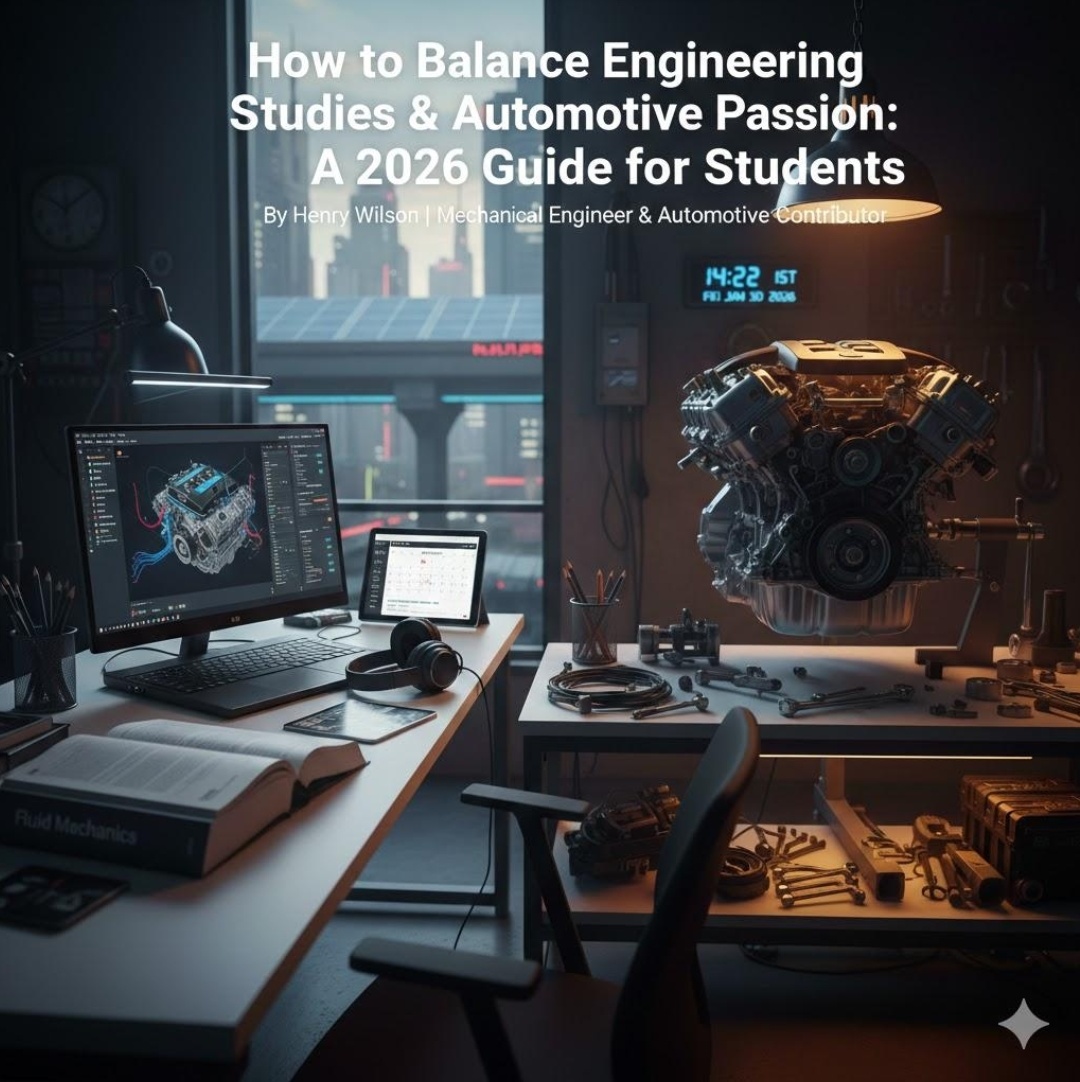
By Henry Wilson | Mechanical Engineer & Automotive Contributor
For most of us, the sound of a cold start or the smell of fresh tire rubber is more therapeutic than any meditation app. I’ve spent countless nights with grease under my fingernails and a Fluid Mechanics textbook open on the workbench.
I know the struggle: as we head into the 2026 academic year, the pressure on students—from Thanaweya Amma in Egypt to SPM/STPM candidates in Malaysia—is hitting the redline. Between university lab reports and mastering complex CAD software, your project car or bike often ends up under a dusty cover. But you don’t have to choose between a high GPA and a great ride. Here is how to balance horsepower with homework.
1. Use the “Pit Stop” Productivity Method
In racing, a pit stop isn’t a distraction; it’s a strategic necessity to stay in the race. Treat your engineering study sessions with the same mechanical efficiency.
- The Tactic: Use a modified Pomodoro technique. Study for 50 minutes (The Stint) focusing on high-logic tasks like Fluid Mechanics or Circuit Analysis, then take a 10-minute “Pit Stop” to check out the latest automotive news or clean your gear. If you find yourself stuck on a complex derivation, you can always seek engineering assignment help to keep your momentum steady.
- The Reward: Complete a major milestone—like finishing a Calculus III problem set—before allowing yourself a “Track Day” or a long ride through Sokhna (Egypt) or up the Genting Highlands (Malaysia).
2. Bridge the Gap: Your Machine is a 3D Lab
As an engineer, stop looking at your bike or car as a distraction and start seeing it as a physical textbook. This is where your experience meets your expertise. However, transforming your mechanical knowledge into a high-grade report requires a specific skill set. To succeed, students must master academic writing for 2026 and beyond, as the ability to document technical findings clearly is what separates a hobbyist from a professional engineer.
- Applied Physics & Dynamics: Every time you calculate lean angles on a corner or adjust your suspension dampening, you’re practicing Applied Physics in real-time.
- Thermodynamics in Motion: Understanding your engine’s cooling system or turbocharger efficiency is literally your Heat Transfer module in action.
When you connect academic theory to the machine in your garage, studying stops being a chore and becomes a research project for your passion.
3. Managing the “Heavy Cargo” with Technical Academic Support
In my years in the field, I’ve realized the smartest engineers aren’t just the ones who study the hardest—they are the ones who manage their resources most efficiently.
There will be weeks when midterms collide with a major mechanical failure or a once-in-a-year enthusiast meet in Cairo or Kuala Lumpur. When your academic workload becomes “overweight,” it’s okay to call for technical backup. Students looking for reliable assignment help Malaysia at Myassignmenthelp.com can easily navigate complex technical essays, research papers, or engineering dissertations that require precise formatting.
Just as a professional racing team has a crew to handle data, getting expert guidance on your coursework ensures you don’t burn out before the finish line.
4. Localize Your 2026 Schedule (Egypt & Malaysia)
Being a student in Egypt or Malaysia means dealing with unique logistical challenges—from Cairo’s unpredictable traffic on the Ring Road to the heavy congestion on the Federal Highway in Klang Valley.
- The 2026 Tech Edge: Use AI-driven planners to sync your exam schedule with local car meets and events.
- The Commute Win: If you’re stuck in traffic, don’t waste the time. Use that hour to listen to automotive engineering podcasts. Turn “dead time” into “lead time.”
5. Join a Student-Biker Community
Don’t be a lone rider. Whether it’s a university car club at GUC (Egypt) or a motorsports society at UTM or Taylor’s University (Malaysia), surrounding yourself with people who understand the “buying parts vs. buying textbooks” struggle is vital.
Frequently Asked Questions
Q.1 Is it possible to maintain a high GPA while being active in the car community?
Absolutely. Many top engineering students use their automotive hobbies as a “mental reset.” The key is using structured methods like the Pomodoro technique and knowing when to delegate non-core tasks through professional academic resources.
Q.2 Can I use my project car for my university thesis?
Yes! Many universities in Egypt and Malaysia (like Cairo University or UTM) encourage “hands-on” final year projects (FYP). Converting a car to electric or optimizing fuel injection systems makes for an excellent engineering dissertation.
Q.3 How do I balance Thanaweya Amma or SPM 2026 prep with my hobby?
Focus on “The Stint” method mentioned above. Use your hobby as a reward for hitting study milestones. Consistency is more important than marathon study sessions.
About the Author: Henry Wilson
Henry Wilson is a Mechanical Engineer and a veteran of the automotive blogging scene. With a background in structural analysis and a lifelong passion for motorcycle restoration, Michael specializes in bridging the gap between rigorous academic theory and real-world mechanical application.